
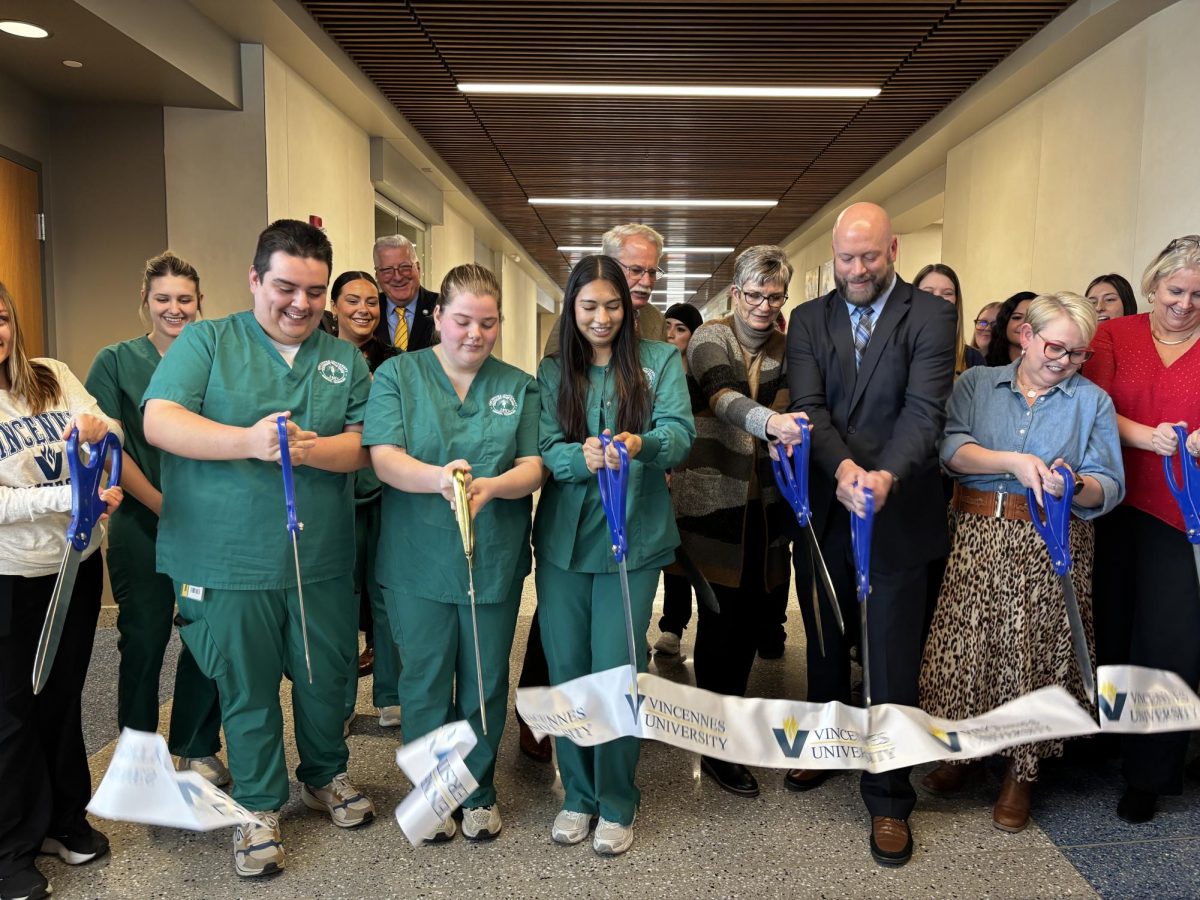
Vincennes University officials gathered on Wednesday to officially celebrate the grand opening of the new Center for Health Sciences and Learning Innovation.
At 72,000 square feet, the $33.9 million facility is the largest building in the university’s history. It will feature ultra-modern clinical simulation labs, high-fidelity manikins, virtual reality simulators, video recording systems, and more.
The ribbon-cutting event was hosted by the university alongside students and faculty from the College of Health Sciences and several local dignitaries, too.
University President Dr. Charles Johnson welcomed the crowd to the event, calling the new building a “spectacle for educational growth.”
“This building is the stepping stone to becoming the innovative front for students to learn and grow,” he told the crowd.
Among the other speakers, Michelle Cummins, the former dean of the College of Health Sciences, reflected on the long journey it took to imagine, design and, finally, construct the new building.
“We imagined something better (than we had), a place with room to think bigger, teach smarter, and prepare students for the workforce,” Cummins said.
The former building was growing out of date, and college leaders envisioned something better for students and faculty alike.
“That vision became a reality,” Cummins told the crowd, her gaze drifting around the new space.
According to Cummins, the new building will be student-centered and faculty-focused. Students will be afforded every resource to be as ready as they can be for the workforce after their time spent at Vincennes University.
Dr. Jason King, the interim dean for the college, echoed this sentiment.
“The new center allows us to meet growing workforce demands by educating students in spaces that mirror the environments they will enter after graduation,” King said.
The building also now houses the university’s Center for the Advancement of Faculty Excellence, led by Dr. Sarah Alderfer.
The CAFE’s new space includes larger areas for faculty to come together to train and collaborate. Alderfer said her goal is that the university’s various colleges and departments can come together to use the new space, one that features larger, more “hands-on classrooms.”
“I want faculty to find community and support to deepen their teaching practices and embrace innovation in the classroom,” she said.
Attendees to the event were also invited to engage in self-guided tours throughout the building after the ribbon cutting. Students and faculty were positioned throughout to show visitors how they use state-of-the art technology to mirror real-life hospital scenarios to best train future healthcare professionals.
The new building was constructed on the site of the old Harrison Hall. It was nearly destroyed during an April 2020 storm. No students were living in the residence hall at the time as they had all been moved out at the start of the COVID-19 pandemic. While not an ideal situation, Johnson called the unusual series of events that led to the site being open and available for the new health science building – and the insurance check that came with it – “serendipitous.”
– Editor Joshua Smith also contributed to this report.